Why Climate-Conscious Events Must Rethink Badge Issuance First
Discover how on-demand badge printing kiosks eliminate plastic waste and no-show badge trash — the smart choice for sustainable MICE events.
Climate Sensitivity: The New Standard Reshaping the MICE Industry

Climate sensitivity refers to the awareness of climate change impacts and the active commitment to reducing carbon footprints across everyday decisions — including how events are planned and executed.
Once the language of environmental scientists and policy advocates, climate sensitivity has rapidly entered mainstream corporate culture. Today, it shapes ESG reporting frameworks, university sustainability policies, and increasingly, the standards by which professional events are evaluated.
The MICE industry (Meetings, Incentives, Conferences, Exhibitions) sits at the heart of this shift. By nature, MICE events concentrate large numbers of people in a single venue over a short period — generating enormous volumes of consumable materials in the process. A single international conference, when accounting for air travel, accommodation, and catering, can produce tens of tonnes of carbon emissions.
As a result, concepts such as Green Event certification, Net-Zero event declarations, and sustainable procurement standards are no longer peripheral topics in global event planning — they are becoming baseline expectations.
Organizations such as Samsung, LG Electronics, Hyundai, and major intergovernmental bodies including ADB and APEC are actively reviewing the carbon efficiency of their event operations as a direct consequence of internal ESG mandates. Venues across Asia — from COEX in Seoul to Suntec in Singapore — are strengthening green operations guidelines to meet these rising demands.
Climate sensitivity is no longer an optional value. It is becoming a core evaluation criterion for how events are planned, delivered, and reported.
Why the Event Entrance Is Your Most Important Environmental Statement
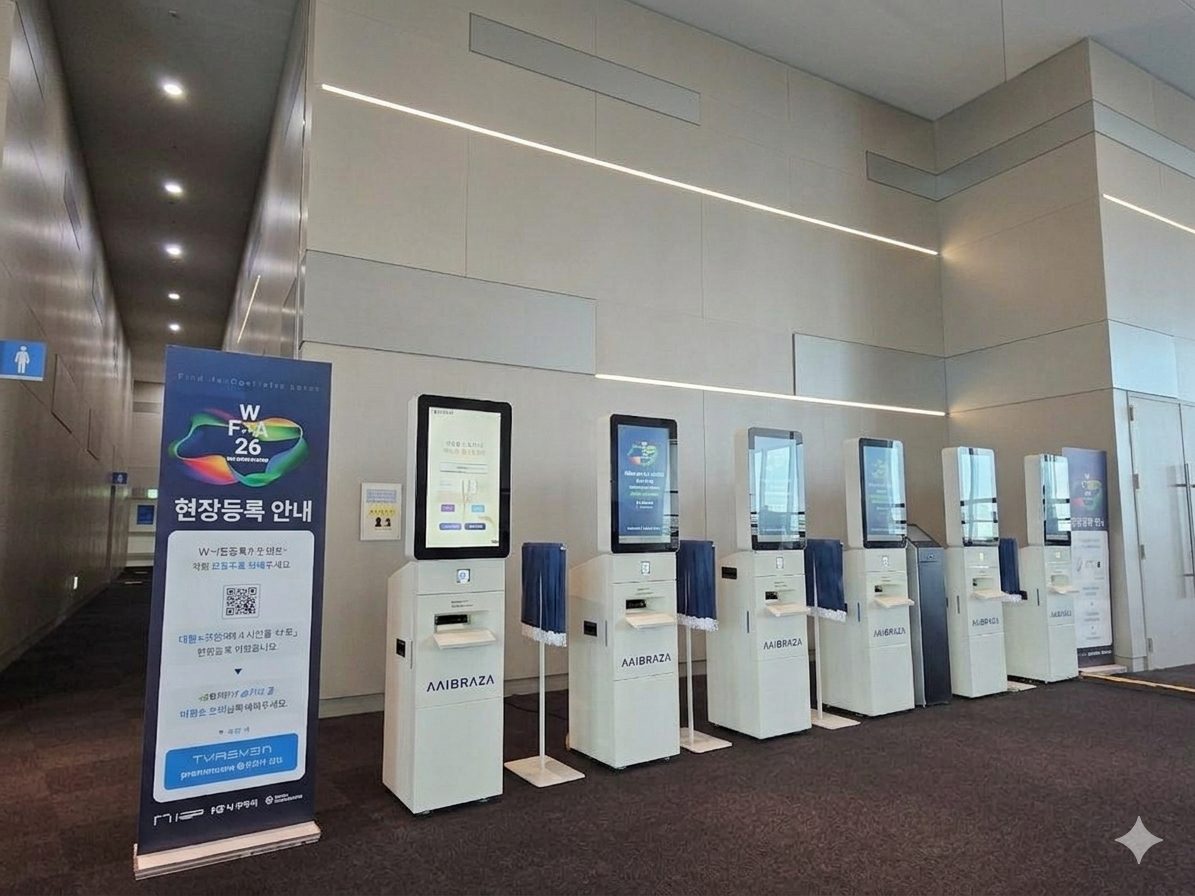
What is the very first physical touchpoint an attendee experiences at your event? Not the keynote stage. Not the networking reception. Not the exhibition floor.
It is the registration desk and badge collection counter.
Event managers routinely invest heavily in opening videos, stage design, and branded gift packages — yet frequently give little thought to the material and method behind the very first item an attendee holds in their hands: their name badge.
This first touchpoint, however, communicates your event’s environmental values more directly than any other element.
Consider what a climate-conscious attendee observes upon arrival:
- A thick plastic badge holder encasing a pre-printed card
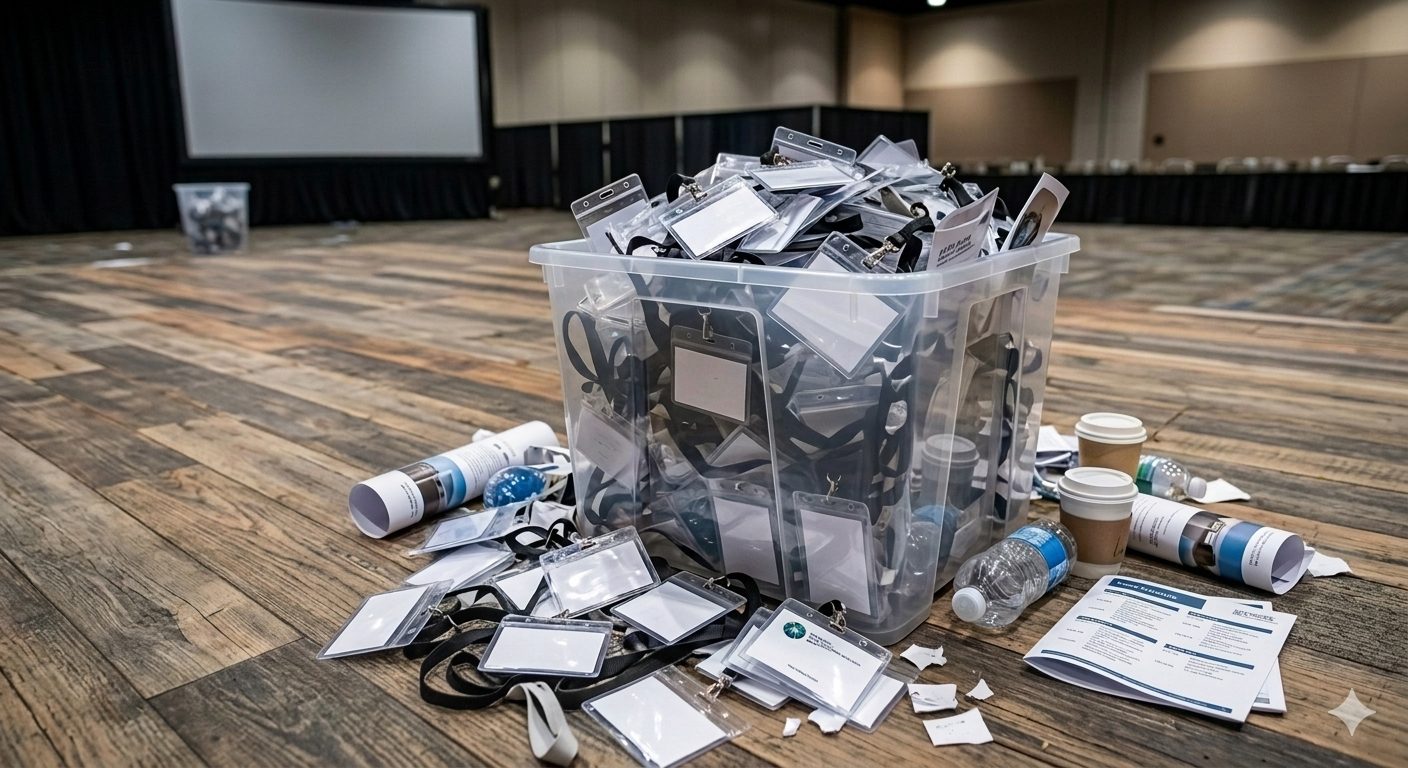
- A bundle of unclaimed badges from no-show registrants sitting discarded on the desk
- A bin near the exit overflowing with PVC lanyards and plastic sleeves
Each of these details sends an implicit message: “This organisation hasn’t thought about that yet.”
Now consider the alternative. An attendee walks up to a sleek self-service kiosk, scans a QR code, and within seconds receives a freshly printed badge — no plastic sleeve, no PVC lanyard, ready to wear. Their immediate reaction: “This event is different.”
That first impression sets the emotional tone for everything that follows — every session, every conversation, every piece of content encountered throughout the day.
Your registration area is not a logistics checkpoint. It is the first communication channel through which your brand values are expressed.
The Hidden Waste Problem: No-Show Badges and Plastic Holders
When the event is over and the venue empties, what remains at the registration desk? Most event managers are surprised when they examine the waste generated by a seemingly routine process.
The Structural Waste of Pre-Printed Badges
| Waste Type | Root Cause | Typical Scale |
|---|---|---|
| No-show badges | Pre-registered attendees who do not attend | 15–30% of total registrations on average |
| Reprinted error badges | Name/organisation misspellings, last-minute changes | Manual corrections or full reprints on-site |
| Unused buffer badges | Printed in advance for walk-in registrations | 10–20% over-production on top of total volume |
| Plastic badge holders | PVC material, non-recyclable | Hundreds to thousands discarded per event |
| PVC lanyards | Mixed-material composite, not sortable | Almost entirely sent to general waste |
The larger the event, the more this waste compounds — not linearly, but exponentially. For a 1,000-attendee conference with a 20% no-show rate, 200 badges are discarded unopened. Combined with their plastic holders and lanyards, this represents a significant volume of composite-material waste that standard recycling systems cannot process.
Why Plastic Badge Holders Are an Urgent Problem Right Now
PVC (polyvinyl chloride), the material used in the majority of badge holders, releases harmful compounds when incinerated and takes hundreds of years to decompose in landfill. Most event badge holders are manufactured from PVC or mixed-PP composites — used for a few hours at most, then discarded.
Across thousands of events held annually in the Asia-Pacific region alone, this accumulates into a staggering volume of non-recyclable plastic waste.
From a climate sensitivity standpoint, eliminating plastic badge holders is one of the most immediately actionable carbon reduction measures available to any event manager — requiring no major budget reallocation and no compromise on attendee experience.
Why On-Demand Badge Printing Kiosks Are the Core Infrastructure of Sustainable Events
The solution is not to eliminate badges entirely. Badges continue to serve critical functions: security access control, networking facilitation, session tracking, and attendee identification. These needs remain valid.
The solution is to change how badges are produced.
On-demand badge printing kiosks restructure the entire waste cycle at its source.
Pre-Printed Badges vs. On-Demand Kiosk Printing: A Direct Comparison
| Criteria | Pre-Printed Badges | On-Demand Kiosk Printing |
|---|---|---|
| When badges are produced | Batch-printed before the event | Printed at the moment of arrival |
| No-show waste | All uncollected badges discarded | No print = no waste |
| Plastic badge holder | Required for structural integrity | No holder needed — worn directly |
| Handling errors and changes | Manual correction or reprint on desk | Instant reprint via kiosk |
| Staffing requirements | Multiple personnel at registration desks | Fully automated, minimal staffing |
| Post-event recyclability | Composite materials, non-sortable | Paper-only, recyclable as paper waste |
FAIRPASS’s unmanned check-in kiosks process attendee verification and badge printing simultaneously through a single QR code scan — reducing queue times and eliminating the need for staffed badge lookup desks.
FAIRPASS’s patent-pending 100% paper badge is engineered to be worn around the neck without any plastic holder or lanyard, and is fully recyclable as standard paper waste after the event.
This is not merely an operational convenience. The combination of on-demand kiosk printing and 100% paper badges structurally eliminates the largest category of event waste at its point of origin. If 200 out of 1,000 registered attendees do not show up, those 200 badges — and 200 plastic holders — are simply never created.
Practical Checklist: Applying Climate Sensitivity to Your Event Operations
Whether you are planning a regional corporate conference, an international academic congress, or a large-scale trade exhibition, the following checklist provides a structured starting point. Begin with the badge and registration stage — it is where the greatest immediate impact is possible.
✅ Badge & Registration Stage
- Have you replaced pre-printed batch badges with on-demand kiosk printing?
- Is your badge material made from renewable or fully recyclable materials?
- Have you completely eliminated plastic badge holders?
- Have you replaced PVC lanyards with cotton, paper, or holder-free alternatives?
- Is your system structured to produce zero badge waste from no-show attendees?
✅ On-Site Operations Stage
- Has kiosk deployment reduced your reliance on single-use printed signage and instruction sheets?
- Are attendees provided with clear guidance on badge recycling at the close of the event?
- Are staff and crew badges subject to the same sustainability standards as attendee badges?
✅ Communications & Reporting Stage
- Have you communicated your sustainable badge approach in pre-event emails or invitations?
- Does your post-event report include quantified environmental outcomes (e.g., kilograms of plastic avoided)?
- Are your green event metrics captured in a format suitable for ESG reporting or internal sustainability disclosures?
Frequently Asked Questions
Q: What exactly is a “climate-sensitive event”?
A climate-sensitive event is one in which every stage of planning and delivery incorporates a conscious effort to minimise carbon emissions and material waste. This goes beyond basic recycling. It means fundamentally rethinking elements that have long been treated as standard practice — pre-printed badges, plastic holders, printed programme booklets — and replacing them with lower-impact alternatives. By embedding sustainable choices from the first moment an attendee arrives, organisers simultaneously strengthen brand credibility and improve the overall attendee experience.
Q: How much waste do event badges actually generate?
The volume is larger than most organisers expect. For a 500-person event, it is common for 75 to 150 or more badges to be discarded before they are ever used. Add single-use plastic badge holders and PVC lanyards, and a single event can generate several kilograms of non-recyclable plastic waste from badge materials alone. Switching to on-demand printing based on actual attendance eliminates this waste almost entirely.
Q: Does on-demand kiosk badge printing deliver a meaningful environmental benefit?
Yes — and the benefit is measurable. Because kiosk-based systems print only when an attendee physically arrives, no badges are produced for no-shows. When paired with a 100% paper badge solution such as FAIRPASS’s badge, the event operates with no plastic holders and no composite lanyards whatsoever. The resulting reduction in plastic waste is a concrete, quantifiable metric that can be included in ESG reports, sustainability disclosures, and post-event communications to sponsors, partners, and stakeholders.
📩 Request a Demo or Consultation
To learn how FAIRPASS can support your organisation’s sustainable event strategy — from kiosk deployment to paper badge integration — contact us at any time:
Changing a single badge changes the entire experience: operational efficiency, environmental impact, and brand perception — all at once.
📬 Contact Us
FAIRPASS is ready to support your next event, whenever you need us.
fairpass@fairpass.world
Changing one badge can simultaneously elevate operational efficiency, environmental responsibility, and brand value.
Ready to streamline your next event?
Get a free consultation — no commitment required.
Get a free quote →