How a Paper Badge Changed an Entire Industry: FAIRPASS and the Rise of K-MICE Standards
FAIRPASS by Blue Origin replaces plastic badges with 100% paper name tags and QR check-in kiosks — setting a new global MICE standard from Korea.
* This content is a media clipping featuring FAIRPASS-related excerpts from official press releases and media coverage. The full original article is available via the source link below.
How a Paper Badge Changed an Entire Industry — FAIRPASS and the K-MICE Global Push
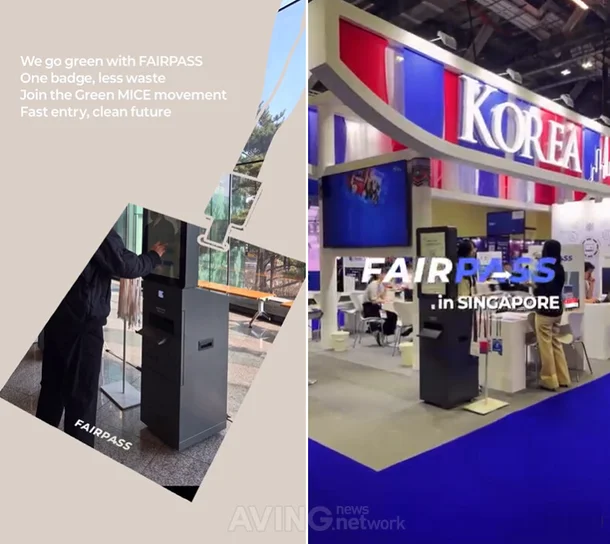
FAIRPASS self-service kiosks in action at a live event, alongside Blue Origin’s booth at a Singapore exhibition. The company has established a local entity in Singapore as its launchpad for global MICE expansion. | Image: Blue Origin
It started with a name badge.
Not just any badge — a 100% paper name tag: the card, the lanyard strap, and even the connector pin, all made entirely from paper. This seemingly simple innovation has quietly dismantled one of the most persistent fixtures of the global events industry — the plastic badge — and is now being positioned as the new benchmark that K-MICE brings to the world stage.
From 500 Misprinted Badges to a Platform Used by 450,000+ Attendees
Seo Yoon Jeon, CEO of MICE-tech venture Blue Origin and creator of the FAIRPASS attendee management platform, spent over two decades on the front lines of international conferences before deciding to rebuild the industry’s operational backbone from scratch.
Her turning point came in 2001. Assigned to manage registrations at an event attended by the South Korean president, she found herself reprinting 500 badges — four times — in a single day due to last-minute changes. Standing in the middle of that chaos, she asked a question that would take 20 years to answer:
“Why doesn’t a system exist that can do this automatically?”
That question became FAIRPASS.
The Problem Every Event Manager Knows Too Well
For anyone who has run a conference or trade show, the registration desk is a familiar battlefield. It’s the first station to open and the last to close. It absorbs the most complaints, demands the most manual labor, and is almost always understaffed at peak arrival times.
Yet for decades, the industry accepted this as simply “how things work.”
Blue Origin decided it didn’t have to.
What FAIRPASS Actually Does
FAIRPASS is built around a self-service kiosk system that automates on-site badge issuance end-to-end. Attendees scan a QR code and receive a printed badge in approximately 14 seconds — no staff intervention required. The platform handles:
- Pre-event online registration and payment
- QR code-based check-in and access control
- On-demand, on-site badge printing via unmanned kiosks
- Real-time attendance tracking and post-event data reporting
Blue Origin describes this as an “Event Identity Infrastructure” — a unified framework that connects every touchpoint of the attendee journey, from initial sign-up through to post-event analytics. For corporate event managers and PCO agencies managing large-scale events, this replaces a fragmented patchwork of separate tools with a single, integrated system.
At scale, the efficiency gains are significant: thousands of manual processing hours eliminated, registration queues reduced dramatically, and on-site staffing requirements cut substantially.
The Sustainability Angle — Built In, Not Bolted On
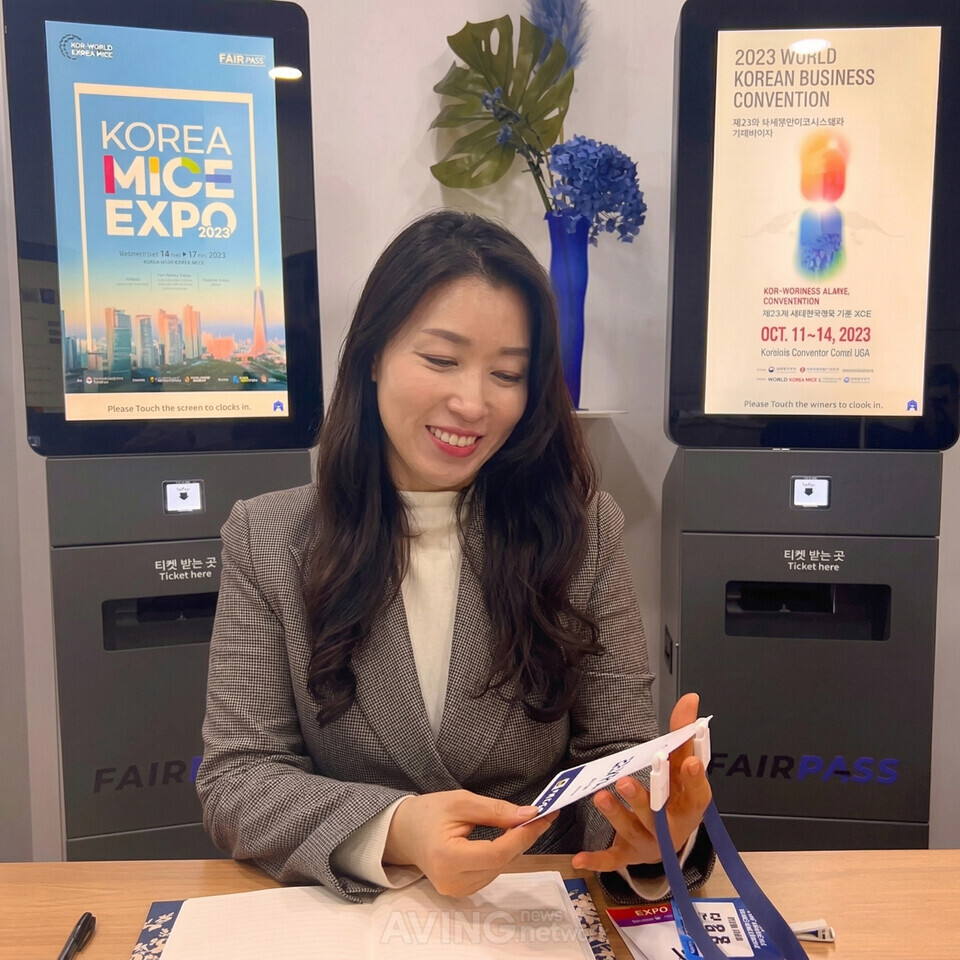
Blue Origin CEO Seo Yoon Jeon demonstrates the fully paper-based FAIRPASS badge system, with a self-service kiosk visible in the background replicating a live event environment. | Image: Blue Origin
Sustainability was not the original design goal — operational efficiency was. But the two converged in an unexpected way.
Anyone who has worked post-event breakdown knows the scene: bin bags overflowing with plastic badge holders, vinyl lanyards, and pin clips. Within the MICE industry itself, there’s an uncomfortable awareness that conferences — by nature — generate significant single-use plastic waste.
Blue Origin engineered its way out of that problem entirely.
Every component of the FAIRPASS badge is made from paper:
- High-durability paper card (replacing the standard plastic PVC badge)
- Paper lanyard strap (replacing the polyester or nylon neck cord)
- Paper connector clip (replacing the plastic buckle or metal pin)
The result: a 100% paper name tag system that requires no sorting, no special disposal, and generates a fraction of the waste of its plastic equivalent.
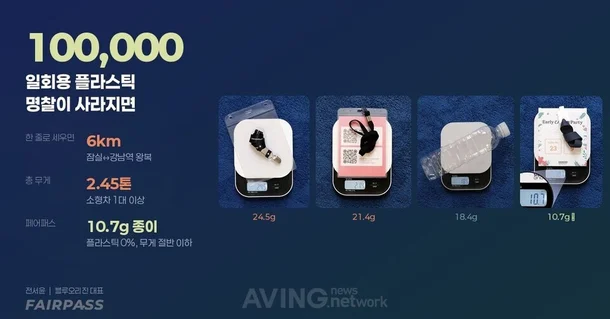
Visual comparison of the waste generated by 100,000 single-use plastic badges versus 100,000 FAIRPASS paper badges, illustrating the environmental impact reduction. | Image: Blue Origin
The technology is protected by three registered Korean patents (Nos. 10-2393849, 10-2385075, and 10-2946034), with international patent applications underway — establishing clear IP ownership as the company scales globally.
Traction: The Numbers Behind the Platform
FAIRPASS is not an early-stage concept. As of publication:
| Metric | Figure |
|---|---|
| Events managed | 150+ |
| Total attendees processed | 450,000+ |
| Events deployed in the past year alone | 50+ |
| Badges issued to date | 140,000+ |
Clients include major Korean and international organizations operating in the exhibition, convention, academic conference, and corporate event sectors — including names such as LG Electronics, Hyundai, Samsung, ADB, APEC, and COEX.
Going Global: Singapore as the Launchpad
Blue Origin has established a Singapore-based legal entity as the foundation for its international expansion strategy. The choice of Singapore is deliberate: as the region’s foremost MICE hub and a gateway to Southeast Asian, European, and North American markets, it positions FAIRPASS directly within the world’s most active international conference ecosystem.
CEO Seo Yoon Jeon frames the global opportunity clearly:
“Markets in Europe and North America are increasingly demanding solutions that deliver both sustainability and operational efficiency — simultaneously. FAIRPASS was designed to meet both requirements without compromise.”
The company has declared 2026 its “Year One of Global Expansion”, with active pursuit of partnerships across Asia-Pacific, Europe, and the Americas.
What “K-MICE” Means for the Global Events Industry
The term K-MICE — Korean MICE — carries a specific ambition here. It’s not simply a geographic label. It represents a set of operational and sustainability standards that Blue Origin believes Korean event technology is now positioned to export to the world.
Seo Yoon Jeon puts it plainly:
“We’re no longer just building a product. We’re defining a standard — a standard where people work smarter, not harder; where events leave less environmental damage behind; and where operations run with greater intelligence. That is what we want K-MICE to mean on the global stage.”
The company name itself reflects this philosophy. “Blue” references the foundational color of the trade show floor; “Origin” signals the ambition to rewrite industry defaults from first principles.
Why This Matters for Corporate Event Managers and PCOs
For event professionals managing large-scale conferences, trade shows, or corporate summits — particularly in markets where ESG reporting and sustainability commitments are now organizational requirements — FAIRPASS addresses a convergence of pressures:
- Operational pressure: Reduce manual staffing burden and eliminate registration bottlenecks
- Environmental pressure: Meet sustainability commitments without sacrificing attendee experience
- Data pressure: Capture clean, structured attendee data across the full event lifecycle
- Vendor consolidation pressure: Replace multiple disconnected tools with a single integrated platform
As procurement teams and event governance frameworks increasingly scrutinize single-use plastic at corporate events, a solution that resolves the badge problem at the infrastructure level — rather than through add-on offsets — represents a meaningful shift.
📰 Source: AVING News via Nate · Published: 6 April 2026 · Category: Media Coverage
📬 Contact Us
FAIRPASS is ready to support your next event, whenever you need us.
fairpass@fairpass.world
Changing one badge can simultaneously elevate operational efficiency, environmental responsibility, and brand value.
Ready to streamline your next event?
Get a free consultation — no commitment required.
Get a free quote →